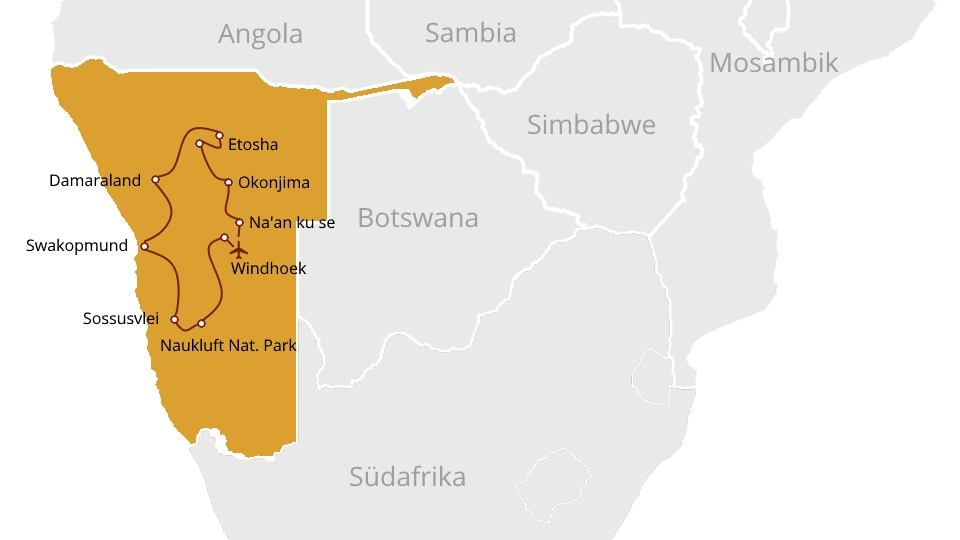
WINDHOEK
Ankunft in Windhoek
Nach der Landung am Hosea Kutako International Airport übernehmen Sie Ihren Mietwagen und fahren zu Ihrer Unterkunft in oder bei Windhoek. Die Stadt liegt eingebettet zwischen den Erosbergen im Osten und dem Khomas-Hochland im Westen und vermittelt sofort ein Gefühl von afrikanischer Weite. Nach dem Check-in bleibt Zeit, sich von der Anreise zu erholen.
Wer Lust auf eine erste Erkundung hat, kann am Nachmittag einen Spaziergang durch das Stadtzentrum unternehmen. Die Christuskirche, der Tintenpalast oder das Independence Memorial Museum sind lohnende Ziele und zeigen die Verbindung von kolonialer Geschichte und moderner Entwicklung. Auch ein Besuch im Namibia Craft Centre empfiehlt sich, um kunstvolle Souvenirs und lokales Handwerk kennenzulernen. Zum Abendessen laden zahlreiche Restaurants ein – von gehobener internationaler Küche bis zu regionalen Spezialitäten wie Wildgerichten oder fangfrischem Fisch. Windhoek ist ein sanfter Einstieg in die Vielfalt Namibias.
WINDHOEK – NAUKLUFT MOUNTAINS
(ca. 280 km / ca. 4:30 Stunden reine Fahrzeit)
Heute beginnt Ihre Selbstfahrer-Rundreise. Die Fahrt führt Sie zunächst durch das Khomas-Hochland, wo sich sanfte Hügel und Farmland mit malerischen Bergketten abwechseln. Weiter südlich passieren Sie den spektakulären Spreetshoogte-Pass, von dessen Aussichtspunkt sich ein grandioser Blick in die Weiten der Namib eröffnet – ein perfekter Stopp für ein erstes Panorama-Foto.
Im Laufe des Nachmittags erreichen Sie die Naukluft-Berge. Ihre Lodge liegt idyllisch eingebettet inmitten zerklüfteter Felsen, die Teil des Namib-Naukluft-Parks sind. Hier dominieren schroffe Schluchten, tiefe Canyons und eine faszinierende Vegetation, die sich den extremen Bedingungen angepasst hat. Am Abend genießen Sie die Ruhe der Natur und lassen den Tag bei einem Sundowner in eindrucksvoller Landschaft ausklingen.
NAUKLUFT MOUNTAINS
Aufenthaltstag
Der heutige Tag gehört den Erkundungen in den Naukluft-Bergen. Das Gebiet ist bekannt für seine spektakulären Wanderwege, die durch schmale Schluchten, entlang klarer Wasserläufe und zu natürlichen Pools führen. Wer aktiv unterwegs ist, wählt eine ausgedehnte Wanderung wie den „Olive Trail“ oder „Waterkloof Trail“, die atemberaubende Ausblicke und unvergessliche Naturmomente bieten.
Doch auch wer es ruhiger angehen möchte, kommt auf seine Kosten: Kurze Spaziergänge offenbaren eindrucksvolle Felsformationen, seltene Pflanzen wie die Aloe oder die Köcherbäume und mit etwas Glück Begegnungen mit Klippspringern oder Pavianen. Vogelbeobachter freuen sich über eine artenreiche Avifauna – darunter der bunte Bienenfresser oder der stolze Schwarzadler.
Die Lodge selbst ist ein Ort der Entspannung, ideal, um den Nachmittag am Pool oder auf der Terrasse zu verbringen, während über Ihnen der Himmel in tiefem Blau leuchtet.
NAUKLUFT MOUNTAINS
Aufenthaltstag
Ein zweiter Tag in den Naukluft-Bergen gibt Gelegenheit, die Region noch intensiver zu erleben. Empfehlenswert ist ein Ausflug zum Sesriem Canyon, den der Tsauchab-Fluss über Jahrtausende in den Fels gegraben hat. In der kühlen Schlucht lässt sich eine kurze Wanderung unternehmen, die die geologischen Besonderheiten eindrucksvoll zeigt.
Wer lieber in der Lodge bleibt, kann eine geführte Naturfahrt buchen oder einfach die Ruhe der Umgebung genießen. Der Reiz der Naukluft liegt nicht nur in den spektakulären Landschaften, sondern auch in der Stille, die nur vom Wind und dem Rufen der Vögel durchbrochen wird. Am Abend genießen Sie ein stimmungsvolles Dinner unter freiem Himmel, während die Sonne hinter den Bergen versinkt.
NAUKLUFT MOUNTAINS – SWAKOPMUND
(ca. 370 km / ca. 6:00 Stunden reine Fahrzeit)
Heute setzen Sie Ihre Reise fort und fahren Richtung Westen, bis Sie die Atlantikküste erreichen. Unterwegs durchqueren Sie endlose Ebenen und das zerklüftete Gaub- und Kuiseb-Tal. Ein Stopp in Solitaire lohnt sich unbedingt – die kleine Siedlung ist für ihren legendären Apfelkuchen und die skurrile Sammlung alter Fahrzeuge bekannt.
Kurz vor Walvis Bay verändert sich die Landschaft erneut: Hier können Sie an der Lagune einen Halt einlegen, wo Flamingos, Pelikane und zahlreiche andere Wasservögel leben. Schließlich erreichen Sie Swakopmund, die charmante Küstenstadt mit kolonialem Flair.
Ihre Unterkunft liegt in Strandnähe, und Sie haben Gelegenheit, die Promenade entlang zu spazieren, in Boutiquen zu stöbern oder in einem der gemütlichen Cafés einzukehren. Abends laden hervorragende Restaurants ein, frischen Fisch oder namibische Austern zu probieren – begleitet von einem Glas südafrikanischen Weins. Swakopmund verbindet Abenteuer, Kultur und Genuss auf einzigartige Weise.
SWAKOPMUND
Aufenthaltstag
Swakopmund ist nicht nur ein charmantes Küstenstädtchen, sondern auch das Abenteuerzentrum Namibias. Der heutige Tag steht ganz im Zeichen Ihrer persönlichen Vorlieben. Wer das Meer liebt, unternimmt eine Bootsfahrt oder eine Kajaktour in Walvis Bay, wo Delfine, Robben und Pelikane zum Alltag gehören.
Für Aktive gibt es zahlreiche Möglichkeiten: Quad-Bike-Touren, Fatbike-Ausflüge in die Dünen oder Sandboarding bieten aufregende Perspektiven. Wer es ruhiger angeht, kann die Mondlandschaft und die seltenen Welwitschia-Pflanzen im Hinterland besuchen. Kulturell interessierte Reisende besichtigen das Swakopmund Museum, Galerien oder genießen einen Spaziergang durch die koloniale Architektur im Zentrum.
Am Abend bietet die Mole den perfekten Ort für einen Sundowner mit Blick auf den Atlantik. Die Kombination aus Meeresrauschen, kolonialem Flair und einer entspannten Atmosphäre macht Swakopmund zu einem der beliebtesten Reiseziele Namibias.
SWAKOPMUND
Aufenthaltstag
Ein weiterer Tag in Swakopmund erlaubt Ihnen, das vielfältige Angebot noch intensiver zu nutzen. Empfehlenswert ist eine Living Desert Tour: Erfahrene Guides zeigen Ihnen die faszinierende Welt der „Little Five“ – Geckos, Chamäleons, Käfer und andere kleine Bewohner der Dünen, die sich perfekt an das Leben im Sand angepasst haben.
Wer tiefer in die Kultur eintauchen möchte, kann an einer Township-Tour teilnehmen und Einblicke in das Alltagsleben der lokalen Bevölkerung gewinnen. Auch kulinarisch hat Swakopmund viel zu bieten: Neben den Fischrestaurants finden Sie Cafés im deutschen Stil, urige Biergärten oder moderne Bistros.
Dieser zusätzliche Tag sorgt für eine ausgewogene Mischung aus Erholung, Abenteuer und Kultur, bevor Sie am nächsten Morgen weiter ins Landesinnere reisen.
SWAKOPMUND – SPITZKOPPE
(ca. 160 km / ca. 3:00 Stunden reine Fahrzeit)
Nach erlebnisreichen Tagen an der Atlantikküste verlassen Sie Swakopmund und fahren in das Landesinnere. Die Straße führt zunächst durch weitläufige Ebenen, wo die Landschaft nach und nach trockener und felsiger wird. Schon von weitem erkennen Sie das beeindruckende Massiv der Spitzkoppe, das mit seinen bis zu 1.728 Metern hohen Granitkuppen markant aus der Ebene ragt und nicht umsonst als „Matterhorn Namibias“ bezeichnet wird.
Am frühen Nachmittag erreichen Sie das Spitzkoppe Mountain Tented Camp, das idyllisch am Fuße der Felsformation liegt. Hier bietet sich Ihnen die Gelegenheit, die Gegend bei einem Spaziergang zu erkunden: Zahlreiche Felszeichnungen der San zeugen von uralter Besiedelung. Besonders lohnenswert ist eine kleine Wanderung zu natürlichen Felsbögen und Aussichtspunkten, von denen aus Sie die Weite der Landschaft überblicken.
Wenn die Sonne untergeht, verwandelt sich die Spitzkoppe in ein Farbenspektakel – die Granitkuppen leuchten in intensiven Orange- und Rottönen. Anschließend genießen Sie die besondere Atmosphäre des Camps, während über Ihnen ein klarer Sternenhimmel erstrahlt, wie man ihn nur an wenigen Orten der Welt erleben kann.
SPITZKOPPE
Aufenthaltstag
Der heutige Tag steht ganz im Zeichen von Natur, Ruhe und Entdeckung rund um die Spitzkoppe. Nach einem gemütlichen Frühstück können Sie zu einer geführten Wanderung aufbrechen. Erfahrene Guides führen Sie durch bizarre Felsformationen, enge Schluchten und zu Jahrtausende alten Felsmalereien. Besonders eindrucksvoll ist der „Rock Arch“, ein natürlicher Felsbogen, der bei Fotografen besonders beliebt ist.
Wer es aktiver mag, kann eine anspruchsvollere Wanderung bis in höhere Lagen der Granitkuppen unternehmen. Von dort bietet sich ein grandioser Ausblick über die endlose Savanne, die bis zum Horizont reicht. Unterwegs erfahren Sie mehr über die geologischen Besonderheiten und die erstaunliche Anpassung von Pflanzen und Tieren in dieser kargen Umgebung.
Der Nachmittag eignet sich, um die Stille und Weite einfach zu genießen. Vielleicht beobachten Sie die bunten Klippschliefer, die sich zwischen den Felsen tummeln, oder Sie entspannen im Camp mit einem guten Buch. Am Abend taucht die untergehende Sonne die Landschaft erneut in magisches Licht – ein Erlebnis, das den Aufenthalt unvergesslich macht.
SPITZKOPPE – TWYFELFONTEIN
(ca. 280 km / ca. 5:30 Stunden reine Fahrzeit)
Ihre Reise führt Sie heute weiter in das Damaraland. Nach dem Frühstück verlassen Sie die Spitzkoppe und fahren durch einsame Landschaften mit bizarren Felsformationen, weiten Trockenflüssen und kleinen Siedlungen. Unterwegs lohnt sich ein Abstecher nach Uis, einem ehemaligen Bergarbeiterstädtchen, wo Sie ein Gefühl für das ländliche Namibia bekommen.
Mit etwas Glück sehen Sie unterwegs die berühmten Wüstenelefanten, die sich in den ausgetrockneten Flussläufen auf Nahrungssuche begeben. Am frühen Nachmittag erreichen Sie Twyfelfontein, eine Region von weltweiter Bedeutung, die zum UNESCO-Welterbe zählt.
Am Nachmittag haben Sie Gelegenheit, die berühmten Felsgravuren zu besichtigen. Hier haben die San vor Tausenden von Jahren über 2.500 Abbildungen von Tieren, Jagdszenen und spirituellen Symbolen in den roten Sandstein gemeißelt. Ein weiteres Naturwunder in der Umgebung sind die Orgelpfeifen, säulenartige Basaltformationen, und der nahegelegene Verbrannte Berg, dessen dunkle Oberfläche an vulkanische Aktivität erinnert. Der Abend gehört dann der Lodge, wo Sie bei einem Sundowner den Tag ausklingen lassen.
TWYFELFONTEIN – ETOSHA NATIONALPARK (SÜD)
(ca. 330 km / ca. 5:30 Stunden reine Fahrzeit)
Am Vormittag setzen Sie Ihre Fahrt Richtung Norden fort. Die Strecke führt durch das abwechslungsreiche Damaraland mit weiten Ebenen, zerklüfteten Bergen und kleinen Dörfern der Damara und Herero. Unterwegs lohnt es sich, an markanten Aussichtspunkten zu halten und die kontrastreiche Landschaft zu genießen.
Am Nachmittag erreichen Sie den südlichen Eingang des Etosha Nationalparks. Schon auf der Fahrt zur Unterkunft erleben Sie erste Tierbeobachtungen: Antilopenherden ziehen durch die Savanne, Giraffen äsen an den Bäumen, und mit etwas Glück zeigen sich auch Elefanten oder sogar Löwen.
Ihre Lodge liegt unweit des Parkeingangs und bietet ideale Möglichkeiten, die kommenden Tage ganz den Safaris zu widmen. Am Abend können Sie an einer Wasserstelle verweilen und die Tierwelt beobachten – ein eindrucksvolles Schauspiel, das Sie auf die kommenden Safari-Erlebnisse einstimmt.
ETOSHA NATIONALPARK (SÜD)
Aufenthaltstag
Heute widmen Sie sich voll und ganz der Tierbeobachtung im Etosha Nationalpark, einem der bedeutendsten Wildschutzgebiete Afrikas. Früh am Morgen, wenn die Temperaturen noch angenehm sind und viele Tiere aktiv, starten Sie zur ersten Pirschfahrt. Die endlose Weite des Parks wird immer wieder von Wasserstellen unterbrochen, an denen sich eine große Vielfalt von Tieren versammelt. Mit etwas Glück sehen Sie Elefanten, die sich im Wasser abkühlen, Zebras, die in großen Herden über die Savanne ziehen, und Antilopenarten wie Oryx, Springbock oder Kudu.
Ein besonderes Erlebnis sind die Raubtiere: Löwen, die im Schatten ruhen, Hyänen, die neugierig durch das Gras streifen, und vielleicht sogar ein Leopard, der sich im dichten Busch verbirgt. Der Park beherbergt über 100 Säugetierarten, dazu unzählige Vogelarten – darunter Adler, Geier und bunte Trappen.
Mittags kehren Sie zur Lodge zurück und genießen eine Ruhepause, bevor es am Nachmittag erneut in den Park geht. Im warmen Licht der sinkenden Sonne entstehen stimmungsvolle Fotos, wenn Giraffen mit eleganten Bewegungen zur Wasserstelle schreiten oder eine Elefantenherde majestätisch die Straße überquert. Am Abend klingt der Tag bei einem Sundowner aus, während über Ihnen der afrikanische Sternenhimmel erstrahlt.
ETOSHA NATIONALPARK (SÜD – OST)
Pirschfahrt & Fahrt durch den Park (ca. 150 km / ganztägig)
Heute durchqueren Sie den Etosha Nationalpark von Süd nach Ost. Der gesamte Tag steht im Zeichen von Safari-Erlebnissen, da Sie auf der Strecke zahlreiche Wasserstellen und verschiedene Landschaftsformen kennenlernen. Die Etosha-Pfanne – eine riesige, glitzernde Salzpfanne, die aus dem All sichtbar ist – bildet das Zentrum des Parks. Während der Trockenzeit wirkt sie wie eine surreale, endlose Fläche, in der Hitze flimmert; nach Regen verwandelt sie sich in einen Ort, an dem sich unzählige Flamingos versammeln.
Unterwegs haben Sie immer wieder Gelegenheit, die „Big Four“ des Parks – Elefant, Nashorn, Löwe und Leopard – aufzuspüren. Aber auch kleinere Tiere sind faszinierend: Schakale, Mangusten, Warzenschweine oder bunte Vögel wie der Gabelracke. Ihre Route führt durch offene Savannen, dichte Mopane-Wälder und karge Ebenen – ein ständiger Wechsel der Szenerie.
Am Nachmittag erreichen Sie den östlichen Bereich des Parks und schließlich Ihre Lodge, die ideal gelegen ist, um den kommenden Tag entspannt in der Natur zu verbringen. Die Eindrücke dieses intensiven Safaritages begleiten Sie beim Abendessen in authentischer Atmosphäre.
ETOSHA OST – WATERBERG REGION
(ca. 330 km / ca. 5:30 Stunden reine Fahrzeit)
Nach erlebnisreichen Safari-Tagen verlassen Sie den Etosha Nationalpark und fahren Richtung Süden in die Waterberg-Region. Die Fahrt führt durch weitläufige Farmgebiete und Dörfer, die einen Eindruck vom ländlichen Leben in Namibia vermitteln. Immer wieder säumen Termitenhügel die Straße, und Strauße sowie Antilopen sind häufig zu sehen.
Am frühen Nachmittag erreichen Sie die Kambaku Safari Lodge, die inmitten eines privaten Wildreservats liegt. Schon bei der Ankunft wird klar: Hier steht das Erlebnis „Natur pur“ im Vordergrund. Am späten Nachmittag unternehmen Sie Ihre erste Pirschfahrt im offenen Geländewagen. Neben den klassischen Wildtieren wie Zebras, Giraffen und Antilopen stehen hier auch Aktivitäten wie Reitsafaris oder geführte Naturspaziergänge zur Wahl.
Beim Abendessen auf der Terrasse der Lodge genießen Sie nicht nur exzellente Küche, sondern auch den Blick in die weite afrikanische Landschaft. Die Atmosphäre ist familiär und naturnah – ein schöner Kontrast zu den großen Nationalparks.
WATERBERG REGION
Aufenthaltstag
Der heutige Tag gehört dem Entdecken und Genießen der Waterberg-Region. Nach einem entspannten Frühstück können Sie an einer Reitsafari teilnehmen – die Lodge ist für ihr hervorragendes Reitangebot bekannt. Vom Pferderücken aus erleben Sie Zebras, Kudus und Impalas in ihrer natürlichen Umgebung aus nächster Nähe – ein intensives und zugleich leises Naturerlebnis.
Alternativ bietet sich eine geführte Wanderung im Reservat an. Erfahrene Guides erklären die Flora und Fauna, zeigen Spuren im Sand und berichten Spannendes über das Ökosystem. Für Vogelliebhaber ist die Gegend ein Paradies: Vom kleinen Webervogel bis zum majestätischen Adler lassen sich zahlreiche Arten beobachten.
Der Nachmittag steht Ihnen zur freien Verfügung. Ob am Pool mit Blick über die Savanne, bei einer weiteren Safari oder einfach in Ruhe mit einem Glas Wein in der Hand – hier finden Sie den perfekten Ausgleich von Aktivität und Entspannung. Am Abend genießen Sie ein mehrgängiges Dinner in stilvoller Atmosphäre, während draußen die Grillen zirpen.
WATERBERG – OKONJIMA
(ca. 180 km / ca. 3:00 Stunden reine Fahrzeit)
Ihre Reise führt Sie weiter in das Okonjima Nature Reserve, Heimat der renommierten AfriCat Foundation, die sich dem Schutz von Leoparden, Geparden und Hyänen widmet. Schon auf der Fahrt ins Reservat erleben Sie die abwechslungsreiche Landschaft: Farmland, Buschland und bewaldete Hügel wechseln sich ab.
Am Nachmittag unternehmen Sie eine geführte Safari im Reservat. Hier steht vor allem der Schutz bedrohter Raubkatzen im Vordergrund, sodass Sie ausgezeichnete Chancen haben, Leoparden in freier Wildbahn zu beobachten. Auch Geparden, die in großzügigen Arealen ausgewildert werden, können oft gesichtet werden. Neben Raubkatzen beherbergt das Reservat zahlreiche Antilopenarten, Warzenschweine und eine vielfältige Vogelwelt.
Nach einem erlebnisreichen Tag lassen Sie den Abend in der Lodge ausklingen. Mit ihrem stilvollen Ambiente und der eindrucksvollen Lage im Reservat ist sie ein Highlight der Reise.
OKONJIMA – NA’ANKUSE
(ca. 220 km / ca. 3:30 Stunden reine Fahrzeit)
Nach dem Frühstück fahren Sie weiter in das Greater Windhoek Area und erreichen die Na’ankuse Lodge, die sich ganz dem Naturschutz verschrieben hat. Das private Reservat ist bekannt für seine Projekte zur Rehabilitation verletzter oder verwaister Wildtiere.
Am Nachmittag haben Sie Gelegenheit, an einer der angebotenen Aktivitäten teilzunehmen: Eine geführte Safari im offenen Geländewagen, bei der Sie Giraffen, Antilopen, Schakale und mit etwas Glück auch Raubkatzen sehen. Alternativ können Sie eine „Carnivore Feeding Tour“ buchen, bei der Sie Geparden, Leoparden oder Wildhunde aus nächster Nähe erleben und mehr über die Arbeit der Stiftung erfahren.
Am Abend entspannen Sie in der Lodge und genießen die besondere Atmosphäre – eine gelungene Mischung aus Safari-Abenteuer, Luxus und Naturschutz.
NA’ANKUSE
Aufenthaltstag
To conclude your trip, you will spend one more day at Na’ankuse. There, you will gain insights into the foundation's work and learn more about projects dedicated to protecting Namibia's wildlife. Join a guided walk with a San guide, who will vividly demonstrate how his ancestors lived in harmony with nature. You will learn about traditional medicinal plants, spot tracks in the sand, and experience a completely different perspective on the landscape.
Optionally, you can choose to go on another safari or simply enjoy your time at the lodge—whether by the pool, with a massage, or just taking in the vast views of the reserve. This final day offers the perfect opportunity to reflect on the many impressions of your journey and enjoy some peace and quiet.
In the evening, the trip comes to an atmospheric close with a final sundowner in the heart of the Namibian wilderness, before heading back to Windhoek the next day for your flight home.
CENTRAL NAMIBIA - AIRPORT
(approx. 30 km / 0:30 h)
Today is your last day in Africa. If your flight isn't until the evening, you can spend some more time exploring Windhoek and its sights. Or perhaps you'd like to stroll through the shops in search of a souvenir? You will head back to the rental station in good time before your flight to return your car.